Matilda “Tillie” Wiggins Fuller (1876–1953)
A Quiet Beginning to a Life of Great Change
Matilda “Tillie” Wiggins was born on December 15, 1876, in the quiet hills of Mount Olivet, Robertson County, Kentucky, a rural community shaped by tobacco fields, winding creeks, and families who had worked the same soil for generations. Her early life unfolded in a world of small farms, close-knit neighbors, and the steady rhythm of country living in post–Civil War Kentucky. Like many women of her time and place, Tillie grew up in a landscape defined by hard work, deep family ties, and the quiet expectation that she would one day build a home of her own. Her story begins in these rolling Kentucky hills—a world both humble and enduring, where ordinary lives were woven into the fabric of the land itself.
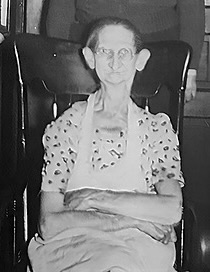
Photograph enhanced for clarity; original image preserved.
Lineage
Cynthia Kolf → Henry Lloyd Fuller, Jr. → Henry Lloyd Fuller → Matilda “Tillie” Wiggins Fuller
Family Line: Fuller
Relationship to Me: My great-grandmother
Generation: 3 generations back
Vital Statistics
Name: Matilda “Tillie” Wiggins Fuller
Born: December 15, 1876, in Mount Olivet, Robertson County, Kentucky
Parents: John Charles Wiggins and Elizabeth Jane Mullikin
Married: Roman Leslie Fuller – May 13, 1895, in Maysville, Mason County, Kentucky
Died: November 1, 1953, at Speers Hospital in Dayton, Kenton County, Kentucky
Cause of Death: Cardiovascular disease and arteriosclerosis; fractured left hip on September 17, 1953 (contributing factor)
Burial: Evergreen Cemetery, Southgate, Campbell County, Kentucky
Children of Leslie & Tillie (Wiggins) Fuller
- Floyd Fuller (1897 – 1976)
- Henry Lloyd Fuller (1900 – 1979)
- Omar D. Fuller (1903 – 1988)
- Margaret Helen Fuller (1913 – 1991)
Early Life in Robertson County
Tillie was born into a Kentucky household, but not into a family that had been rooted there for generations. Her parents, John Charles Wiggins and Elizabeth Jane Mullikin, were part of the steady westward movement that shaped much of 19th-century America. Like many families of their era, the Wigginses and Mullikins moved gradually, following opportunity, farmland, and stability rather than deep ancestral ties to one place. By the time Tillie was born in 1876, Robertson County had become their home.
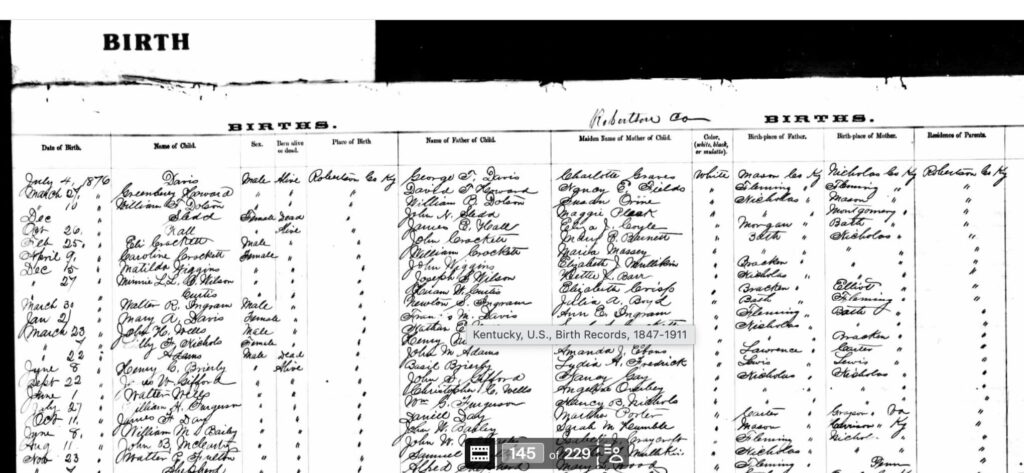

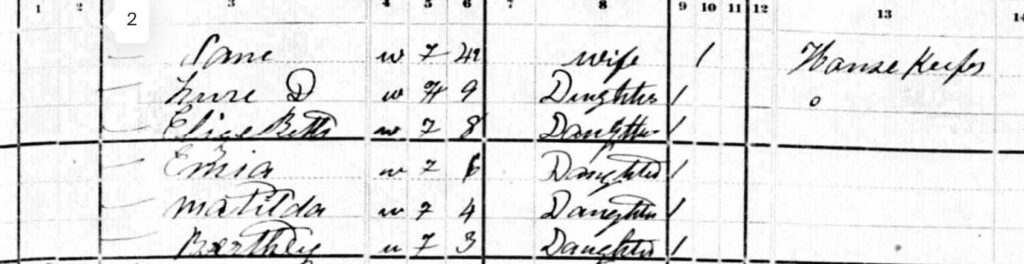
daughter of John Wiggins and Elizabeth J. Mullikin.
The 1880 census recorded four-year-old Tillie living with her family in Mitchells Mills, where her father worked as a farmer. This was a rural world shaped by labor done by hand, reliance on neighbors and extended family, and a daily rhythm governed by the seasons. Though the family may not have lived in Kentucky for generations, they quickly became part of the agricultural fabric of the county.

Education opportunities in rural Robertson County were limited, particularly for girls. School attendance often depended on farm needs, and children moved in and out of the classroom as work required. By the time Tillie appeared in the 1940 census, she reported completing the fifth grade, a level typical for rural women of her generation.
Tillie’s childhood was shaped not only by the land she lived on, but by the quiet persistence of families who had arrived from elsewhere and built a life piece by piece. She grew up in a household that knew change, movement, and adaptation—experiences that would echo throughout her adult life as she followed her husband from farm to farm and eventually into the city.
Marriage and Home Life
As required by Kentucky law, Leslie Fuller filed a marriage bond in Mason County prior to his marriage to Matilda “Tillie” Wiggins, a legal assurance that no obstacle stood in the way of their union.
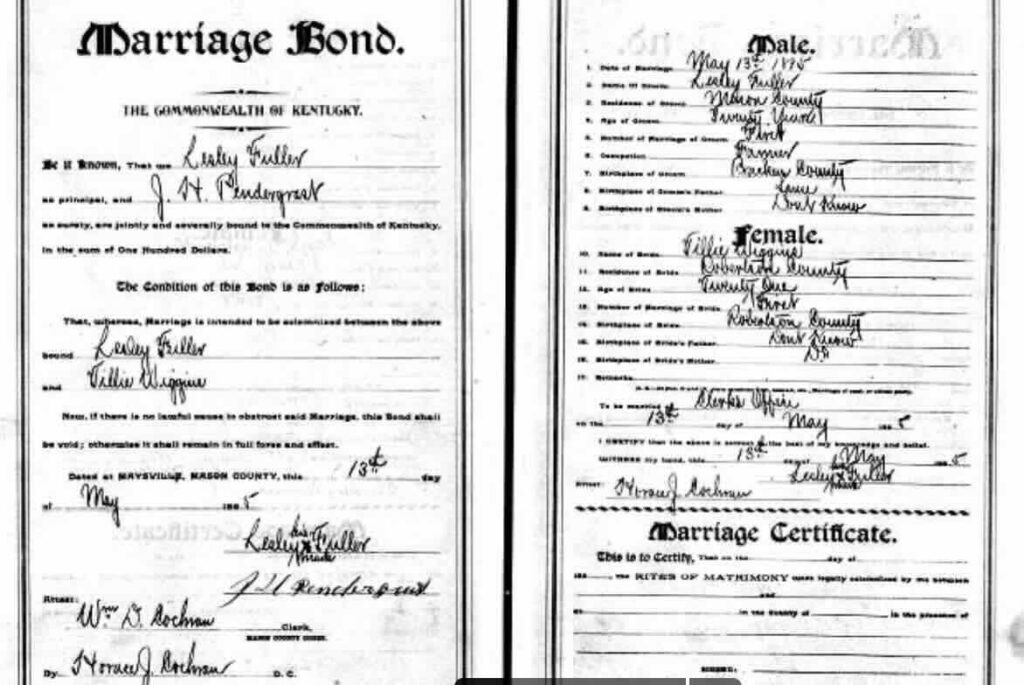
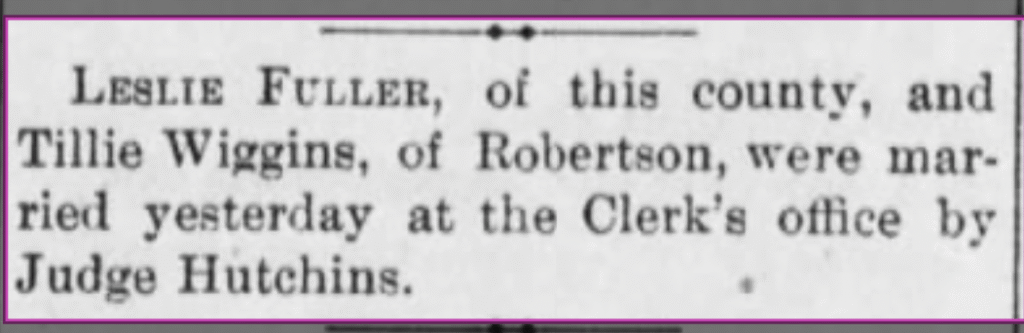
Leslie Fuller and Matilda “Tillie” Wiggins were married on May 13, 1895, at the Clerk’s Office in Maysville, Mason County, Kentucky, by Judge Hutchins, a union later reported in the May 14, 1895, edition of The Evening Bulletin.
Together they raised four children:
- Floyd Fuller
- Henry Lloyd Fuller
- Omar D. Fuller
- Margaret Helen Fuller
Tillie never worked outside the home, yet her labor sustained every one of the Fuller family’s moves and transitions.
A Life Lived Through Changing Times: 1900–1930
1900 — Rural Kentucky: Life by Lamplight
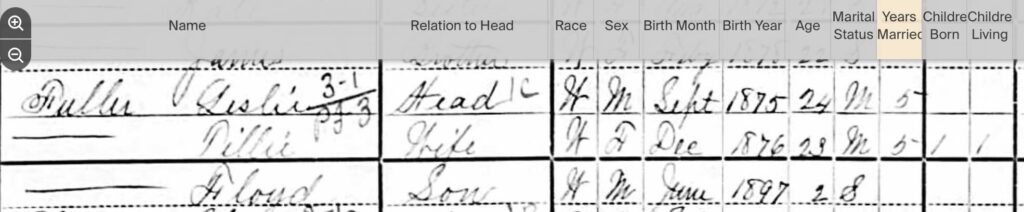
In 1900, Tillie and Leslie lived in Plugtown, Mason County, a community without electricity or indoor plumbing. Homes were lit by kerosene lamps and meals prepared on woodstoves. Leslie worked as a farm laborer, performing the exhausting work typical of rural families at the turn of the century.
1910 — Share Farming and Slow Change
By 1910, the family lived on Tachape & Ripley Road in Mason County. Leslie worked “on share,” paying for the land through crop yield. Rural Kentucky remained unchanged—no electricity, no plumbing, and little modernization. Tillie managed a bustling household with multiple children and endless chores.
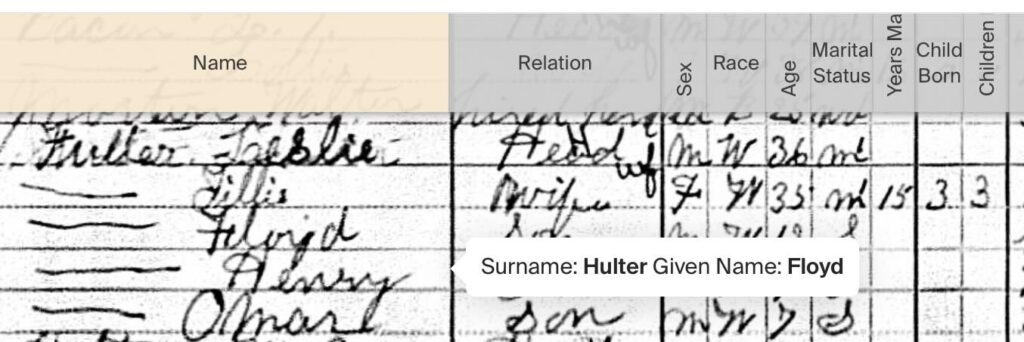
1920 — A Farm of Their Own Account, and a Nation in Transition
By 1920, the Fullers were living in Washington, Mason County, where Leslie was listed in the federal census as a farmer “on his own account.” This designation meant that he was no longer working for wages or farming on shares, but instead operating his own farm business—deciding what to plant, when to sell, and how to manage the work. Though the family continued to rent the land, this step represented a measure of independence and responsibility that marked an important moment in their lives.
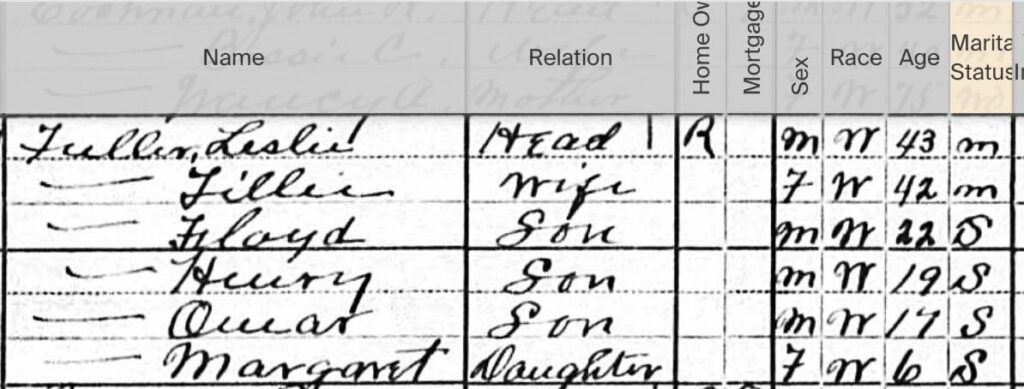
This was also the year women gained the right to vote. Tillie was 44—old enough to remember a world where women had no political voice, yet young enough to witness one of the century’s defining changes.
A Turning Point: The Move to Newport
During the 1920s, likely influenced by economic pressure before the Great Depression, the Fullers left rural Mason County for the urban environment of Newport, Campbell County, directly across the river from Cincinnati.
By 1930, they were living on Columbia Street (414 Columbia Street), surrounded by paved streets, electric lights, streetcars, shops, and closely built houses. Leslie worked in a cement contract business, adapting to city labor after decades on farms.
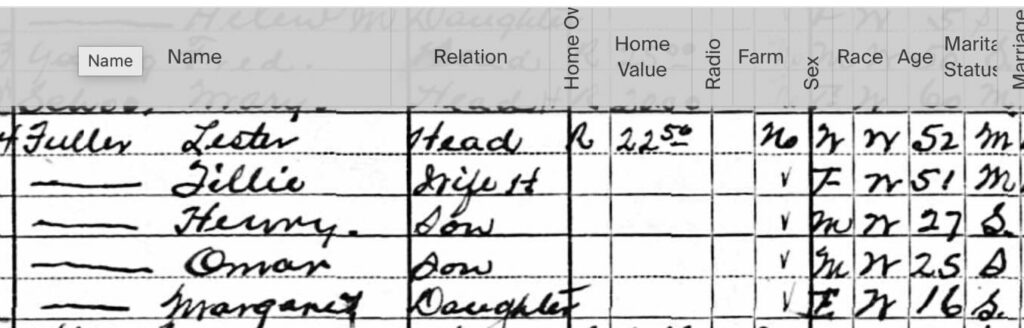
One small but telling detail comes from the 1930 Federal Census: the Fullers reported that they did not own a radio set.
At a time when radios were becoming the centerpiece of American homes—bringing news, entertainment, and even ads into living rooms—this absence speaks quietly but clearly about their economic reality. Renting homes instead of owning them, adjusting to frequent moves, and prioritizing essentials meant that luxuries like a radio were out of reach.
For Tillie, this shift meant adapting to city living, learning new routines, and managing a household in a much more modern—but also more crowded—setting than the farmhouses of her youth.
1940 — Leslie the Peddler & A Changing America
By 1940, the Fullers lived at 225 East 2nd Street in Newport. The census shows their adult son Omar (“Homar” in the record), along with a daughter and young grandson, living in the household—suggesting a return to the family home during a later stage of life.
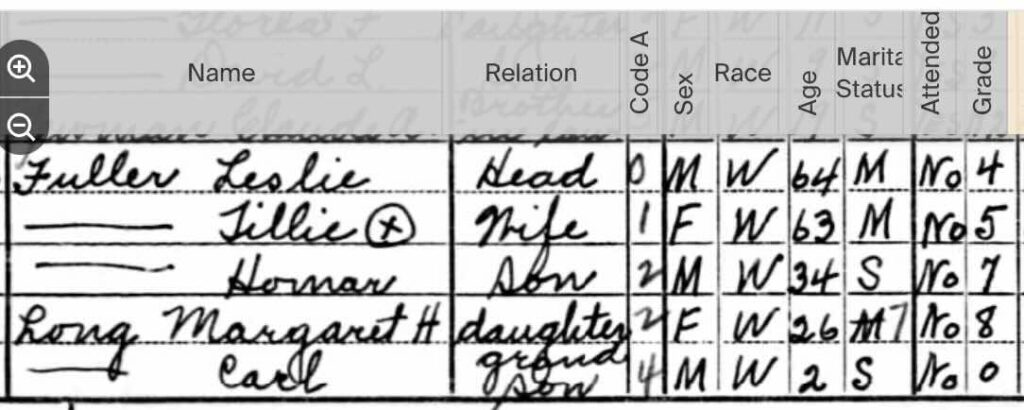
Leslie, now in his sixties, worked as a fruit and vegetable peddler, traveling by horse-drawn wagon—a detail preserved by my father’s memory of riding beside him as a boy.
America was emerging from the Great Depression and entering World War II. Factories in nearby Cincinnati were booming, rationing shaped daily life, and families gathered around radios (for those who had them) to hear war updates. Tillie’s world changed dramatically around her, even though her daily routines remained grounded in home and family.
1950 — Final Years in Newport
By 1950, Tillie and Leslie lived at 107 West 8th Street, still renting, still adapting to new circumstances as needed. Modern conveniences—electricity, running water, gas stoves, automobiles—had become everyday parts of life, a remarkable contrast to the rural world of Tillie’s childhood.

Final Illness and Passing
In September 1953, Tillie suffered a fractured left hip, an often life-limiting injury for elderly women in that era. Complications worsened her existing cardiovascular disease and arteriosclerosis, and she never fully recovered.
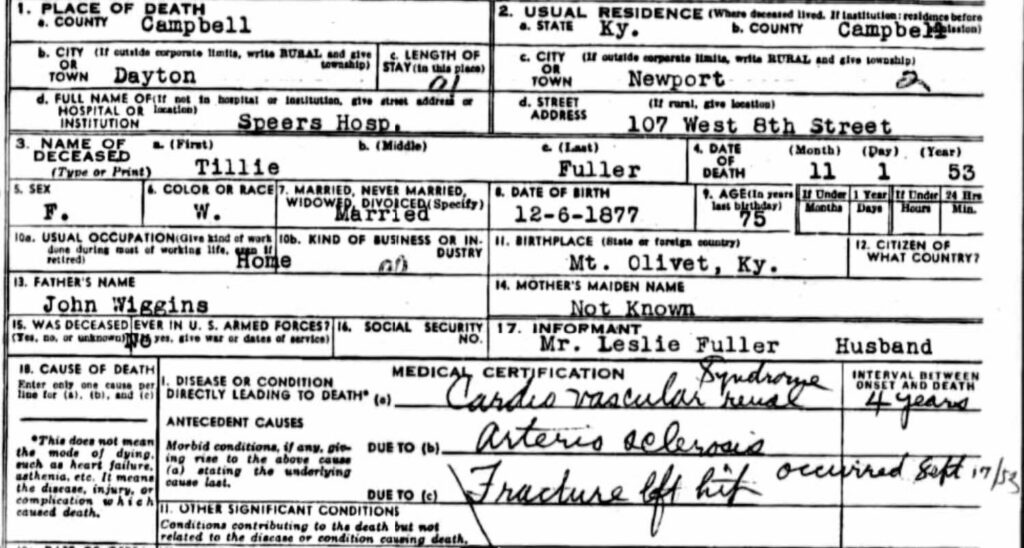
She died on November 1, 1953, at Speers Hospital in Dayton, Kentucky, at the age of 75, and was buried at Evergreen Cemetery in nearby Southgate.
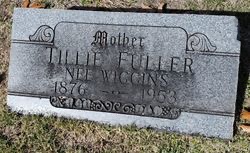
Southgate, Campbell County, Kentucky.
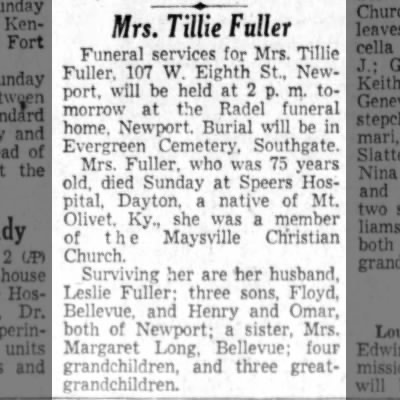
Following Tillie’s death, funeral services were held at the Radel Funeral Home in Newport, Kentucky, with burial at Evergreen Cemetery in Southgate. Her obituary, published in The Cincinnati Enquirer, notes that she was a native of Mount Olivet, Kentucky, and a member of the Maysville Christian Church. She was survived by her husband, Leslie Fuller, their children, grandchildren, and great-grandchildren.
Legacy
Though the documentation of Tillie’s life is limited—census entries, marriage and death records, and family memories—her legacy is far richer. She lived from a time of horse-drawn wagons and hand-pumped wells into a world of electricity, automobiles, radios, and modern medicine. She raised four children, supported her husband through constant changes in work and residence, and quietly anchored her family through seven decades of change.
Her life reminds us that not all legacies are written in headlines; some are carried through generations by memory, resilience, and love.
Sources Used in This Biography
Primary Records
Kentucky Birth Records.
Robertson County, Kentucky. Birth entry for Matilda Wiggins, December 15, 1876. Kentucky Department for Libraries and Archives (KDLA). Accessed 2025.
United States. Tenth Census (1880).
Robertson County, Kentucky. National Archives Microfilm Publication T9. Household of John Wiggins, Mitchells Mills. Accessed 2025.
United States. Twelfth Census (1900).
Mason County, Kentucky. National Archives Microfilm Publication T623. Household of Leslie Fuller. Accessed 2025.
United States. Thirteenth Census (1910).
Mason County, Kentucky. National Archives Microfilm Publication T624. Accessed 2025.
United States. Fourteenth Census (1920).
Mason County, Kentucky. National Archives Microfilm Publication T625. Accessed 2025.
United States. Fifteenth Census (1930).
Campbell County, Kentucky. National Archives Microfilm Publication T626. Accessed 2025.
United States. Sixteenth Census (1940).
Campbell County, Kentucky. National Archives Microfilm Publication T627. Accessed 2025.
United States. Seventeenth Census (1950).
Campbell County, Kentucky. National Archives Microfilm Publication T628. Accessed 2025.
Kentucky County Marriage Records.
Mason County, Kentucky. Marriage bond and marriage record for Leslie Fuller and Matilda “Tillie” Wiggins, May 13, 1895. Kentucky Office of Vital Statistics. Accessed 2025.
Kentucky Death Records, 1852–1965.
Death certificate for Matilda “Tillie” Fuller, November 1, 1953. Campbell County, Kentucky. Kentucky Department for Libraries and Archives (KDLA). Accessed 2025.
Newspapers
The Evening Bulletin (Maysville, Kentucky).
Marriage announcement for Leslie Fuller and Matilda “Tillie” Wiggins, May 14, 1895. Accessed 2025.
The Cincinnati Enquirer (Cincinnati, Ohio).
Obituary for Mrs. Tillie Fuller, November 3, 1953. Accessed 2025.
Find A Grave (Cemetery and Grave Documentation)
Find A Grave.
“Evergreen Cemetery,” Southgate, Campbell County, Kentucky. Cemetery documentation. Accessed 2025.
Find A Grave.
“Matilda ‘Tillie’ Wiggins Fuller,” Memorial ID 218611717. Photograph of grave marker by Chuck Fetters. Accessed 2025.
Photographs & Family Materials
Personal family photograph of Matilda “Tillie” Wiggins Fuller, later years.
Digitally enhanced for clarity; original image preserved. Courtesy of the author.
Personal family recollections and oral history, including accounts of Leslie Fuller’s work as a peddler in Newport, Kentucky.
Historical and Cultural Background Sources
General historical references on:
• Rural life in late 19th-century Kentucky
• Share farming and tenant farming in the Ohio River Valley
• Urban migration from rural Kentucky to Northern Kentucky cities
• Women’s domestic labor and household management, 1900–1950
• Economic and social conditions during the Great Depression and World War II
Accessed 2024–2025 through public-domain historical texts, census documentation, and regional history archives.
This post contains my personal research and writing. Please do not republish or copy without permission. Genealogy is always a work in progress, and information may change as new records come to light.