Andreas Rath (1814–1879): From Württemberg to Kentucky – A Family Story
A Quiet Beginning to a Life of Great Change
In the early 1800s, long before Germany was a unified nation, a boy named Andreas Rath was born into a landscape of small villages, family farms, and centuries-old traditions. He likely grew up surrounded by rolling fields, church bells, and community life shaped by the seasons. By the time he reached adulthood, Europe was shifting rapidly, and like so many young men of his generation, Andreas chose a new beginning across the ocean. His journey would eventually anchor the American branch of the Rath family.
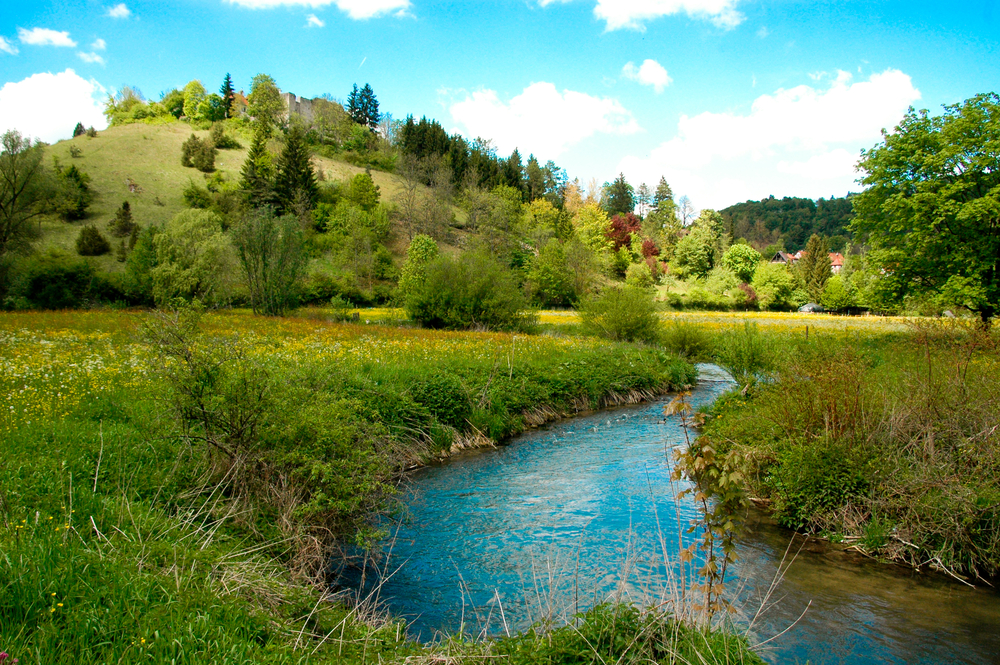
the rural region of Württemberg where Andreas Rath spent his early years.
Lineage
Cynthia Kolf → Dixie Sue Fuller Rath → Elias Elmore Rath → Jacob Rath → Andreas Rath
Family Line: Rath
Relationship to Me: My 2nd great-grandfather
Generation: 4 generations back
Vital Statistics
Name: Andreas Rath
Born: March 15, 1814 — Aldingen (Spaichingen district), Kingdom of Württemberg (Germany)
Note: Depending on the source, his birth year varies between 1814 and 1822.
Parents: Johannes Rath and Ursula Glunz
Marriage: Maria Gruhler — September 4, 1838, Aldingen, Spaichingen district, Kingdom of Württemberg (Germany)
Immigration: 1847 aboard the ship L’Unicorn
Occupation: Farmer (based on census records)
Religion: Lutheran (Evangelische)
Died: May 13, 1879 — Pendleton County, Kentucky
Burial: Old Peach Grove Cemetery, Peach Grove, Pendleton County, Kentucky
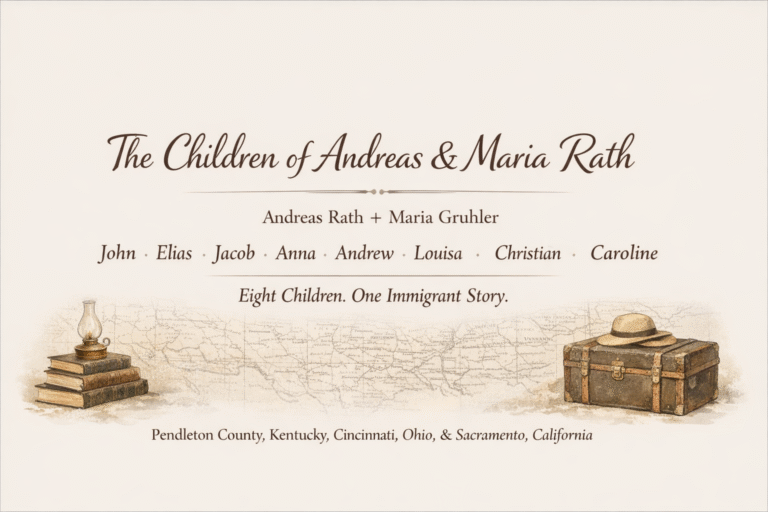
Children of Andreas & Maria (Gruhler) Rath
- Johannes Rath (1839– )
- Elias Rath (1842–1907)
- Jacob Rath (1843–1908)
- Anna Rath (1845–1925)
- Andrew Rath (1846–1924)
- Louisa Rath (1851–1925)
- Christian Rath (1853–1912)
- Caroline Rath (1856– )
- Amelia Rath (1860–1860)

the region recorded in church books as the birthplace of Andreas Rath.
Birth & Homeland in Württemberg
Andreas Rath was born on March 15, 1814, in Aldingen, a village in the Spaichingen district of the Kingdom of Württemberg in southwestern Germany. At the time, Württemberg was an independent kingdom—one of many small states that existed long before the unification of Germany in 1871. It was a land of small farming communities, Lutheran faith, and families who had lived in the same villages for generations.
Aldingen sits at the edge of the Swabian Alps (Schwäbische Alb), a region known for its rolling hills, fertile fields, dense forests, and stone churches that marked the center of village life. The people of this region were called Swabians, known for their strong work ethic, simplicity, and connection to the land. Most residents were farmers, craftsmen, or day laborers who worked close to home, guided by the rhythm of the seasons.
Life in early 19th-century Württemberg was shaped by tradition: Lutheran worship every Sunday, confirmation classes for children, communal harvests, and reliance on extended family. Nearly every important life event—births, marriages, and deaths—was recorded in the local parish registers, which is why a detailed birth record for Andreas survives today.
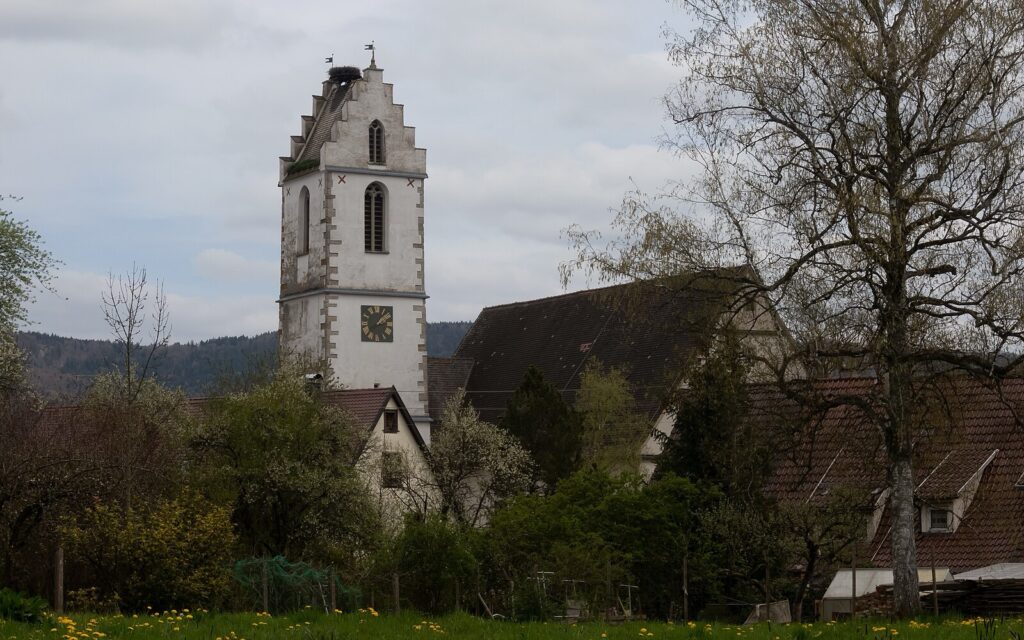
The geography of Aldingen and the surrounding Spaichingen district created a close-knit and self-sufficient world. Though larger towns such as Spaichingen, Tuttlingen, Rottweil, and Stuttgart were within traveling distance, most villagers spent their lives within the familiar boundaries of their home parish. Stone farmhouses, terraced fields, narrow lanes, and wooded slopes formed the backdrop of Andreas’s earliest years—a rural Swabian world that shaped his childhood and character.
Early Life in Württemberg
Andreas grew up in a world that was small in distance but rich in tradition. In Aldingen, life revolved around family, faith, and the land. From a young age, children were expected to help with daily chores—carrying water, gathering firewood, tending animals, helping in the fields, and assisting with household tasks. Work began early and ended only when the day’s needs were met.
Most families in Württemberg lived close to the land. Daily life followed the rhythm of the seasons, with long days of planting, harvesting, animal care, and food preservation. Sundays were devoted to Lutheran worship, and church bells marked the passing of time throughout the week. The local parish served not only as a spiritual center but also as the keeper of vital records, tracking births, baptisms, confirmations, marriages, and deaths.
Education, too, depended on the church. Württemberg had one of the better school systems in early 19th-century Germany, and Andreas likely attended a parish school where he learned reading, writing, arithmetic, Bible study, and hymn singing. At home, he would have spoken the Swabian dialect, a regional variation of German still recognizable today.
As a young man, Andreas worked as a Müllersknecht—a miller’s servant. This detail comes directly from his 1838 marriage record, where his occupation was listed. His father, Johannes Rath, is identified in the same record as a Müller (miller), indicating that Andreas almost certainly worked and apprenticed in his father’s mill.
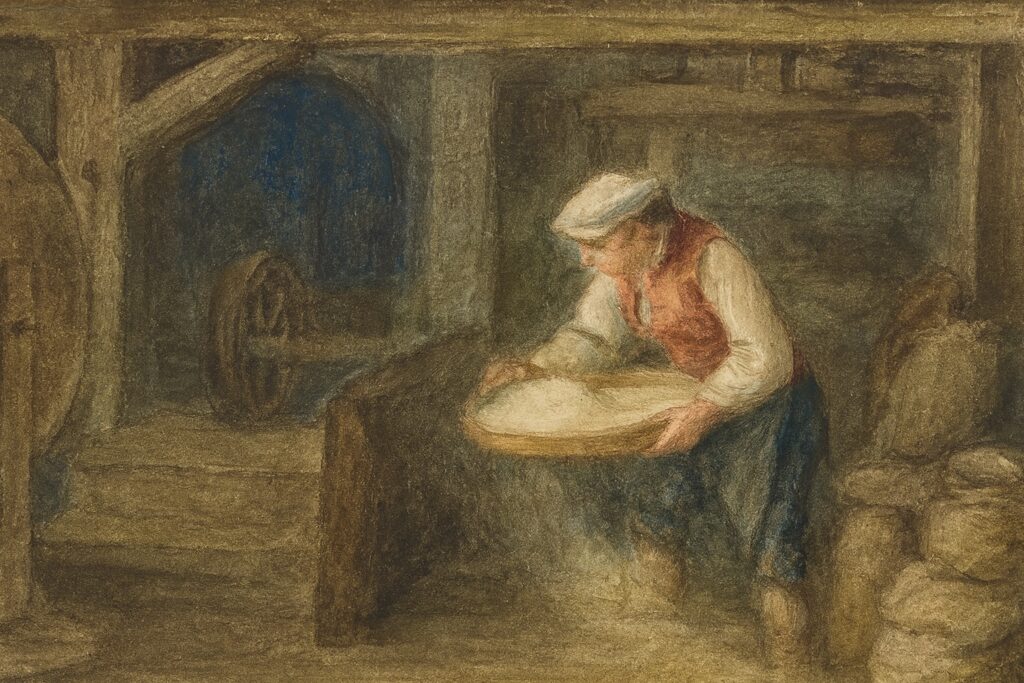
A Müllersknecht held a skilled role, responsible for grinding grain, assisting in mill operations, maintaining the mill race, and learning the trade under the master miller. Working alongside his father would have been the traditional path for a young Swabian man, and the mechanical skills and physical strength required for this work later proved invaluable when Andreas became a farmer in America.
Although village life was steady and deeply rooted, Andreas grew up during a time of mounting challenges. Württemberg faced poor harvests, economic strain, rising population, lack of available land for younger sons, and mandatory military service. These pressures weighed heavily on rural families and limited opportunities for young adults.
By the late 1840s, entire villages were sending sons, daughters, and young families abroad. These internal and external pressures—felt across the kingdom—shaped Andreas’s generation and played a significant role in the life-changing decision he would make in 1847.
It was from this landscape of Swabian hills, family farms, and Lutheran tradition that Andreas chose to leave Württemberg, setting out on the journey that would eventually lead him to America and form the American branch of the Rath family.
Immigration to America (Arrival: July 10, 1847 — New York City)
In the summer of 1847, at the age of 33, Andreas Rath left the Kingdom of Württemberg with his wife and their five young children, whose ages ranged from eight years old down to a baby just nine months old. The decision to leave was immense. They were walking away from the familiar Swabian hills, their extended family, the parish church that had recorded their births and confirmations, and the only way of life they had ever known.
The family traveled to Cherbourg, France, one of the busiest European departure points for German emigrants at that time. Reaching Cherbourg would have required days of overland travel—likely a combination of wagon roads and river routes leading from Württemberg toward the French border. Even before boarding their ship, the journey had already tested their endurance, especially with five small children in tow.
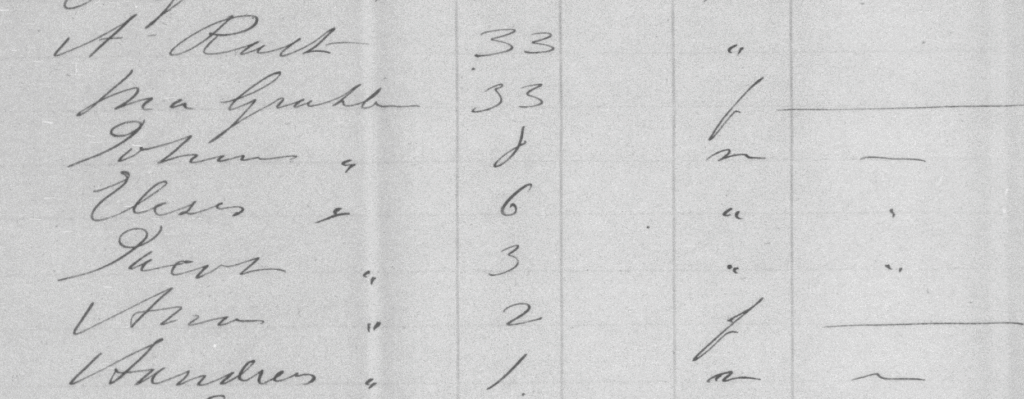
On the ship L’Unicorn, the Rath family joined hundreds of other emigrants seeking a new life in America. Life aboard a mid-19th-century sailing vessel was challenging: cramped sleeping quarters, limited fresh air, bread and dried foods carried from home, and the constant motion of the sea. Andreas and his wife would have spent their days caring for their children, comforting the baby during rough weather, and managing the daily tasks of feeding and caring for a family in steerage.
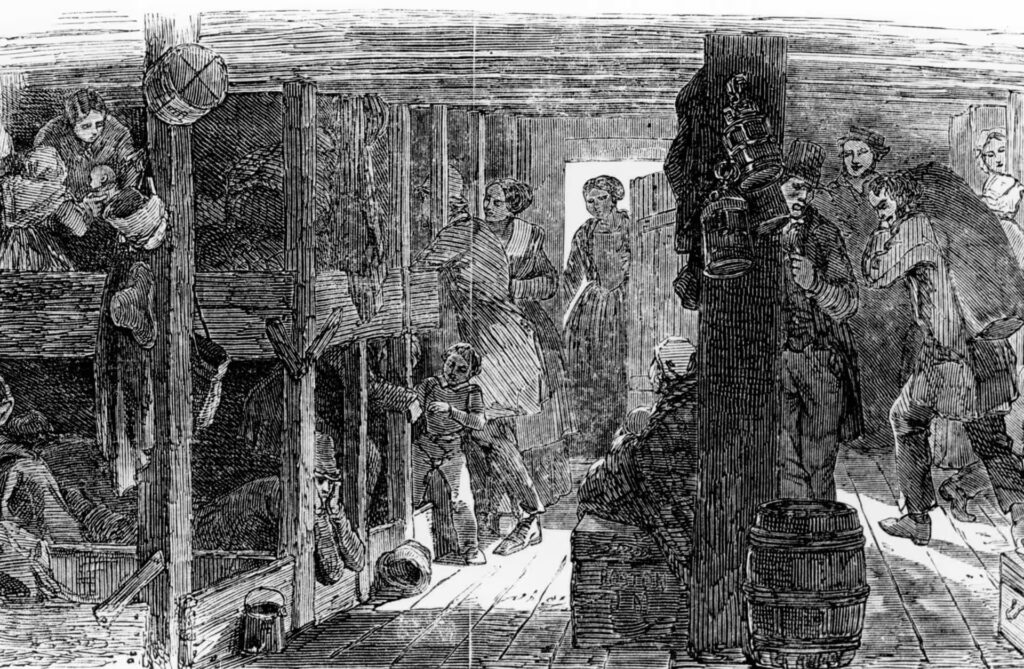
Cramped bunks, poor ventilation, and minimal privacy were typical conditions for passengers like the Rath family. Public domain image, via Wikimedia Commons.
Manifests from this era were prone to small errors, and Andreas was listed as 33 years old, though his birth record gives a birth year of 1814 (making him 33 early in 1847, turning 34 later that year). Such minor age differences were extremely common and are not unusual in immigrant documentation.
Based on typical crossing times of the era, the ship likely departed in late May or early June of 1847 and arrived in New York Harbor on July 10, 1847. This is an estimation; no departure date has been located in surviving records. New York was the busiest entry point for immigrants in the 1840s, long before Ellis Island existed. Families disembarked at crowded piers in lower Manhattan, where they were processed quickly and then left to begin the next stage of their journey. For the Raths, this meant continuing inland along established migration routes toward the Ohio River Valley.
Their arrival in New York marked the beginning of the Rath family’s American chapter—a chapter built on courage, sacrifice, and a hope for a better life for their children.
Life in America (Ohio River Valley / Kentucky Region)
After arriving in New York on July 10, 1847, Andreas and his family traveled inland along the established migration routes toward the Ohio River Valley. This area—stretching across Ohio, Indiana, and Kentucky—was one of the most significant destinations for German immigrants in the mid-19th century. Many followed family networks, letters from friends who had already settled there, or simply the promise of affordable farmland and steady work.
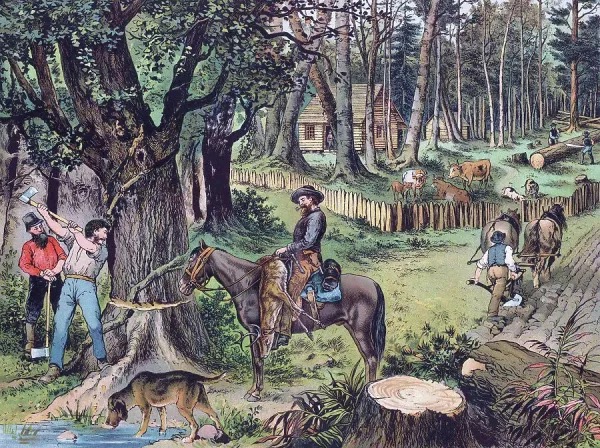
daily work Andreas encountered in northern Kentucky.
Public domain image via Wikimedia Commons.
By the early 1850s, the Rath family had settled in northern Kentucky, an area characterized by rolling fields, wooded ridges, and a growing population of German-speaking settlers. Counties such as Bracken and Pendleton attracted many immigrants from Württemberg and the surrounding German states. The landscape, with its hills, pastures, and small farming communities, would have felt familiar to Andreas after his years in the Swabian Alps.
Census records identify Andreas Rath as a farmer, confirming that he continued the agrarian life he had known in Germany. German immigrant farmers in Kentucky commonly raised grains, vegetables, hogs, and dairy cattle, and many supplemented their income with seasonal labor or by working cooperatively with neighbors. Farming in the mid-19th century required long hours and year-round effort: clearing land, planting crops, maintaining livestock, preserving food, and managing a household with limited tools and little outside help.
The 1860 U.S. census identifies Andreas as a farmer, confirming his shift from the milling trade to agricultural work in Kentucky. Like many German immigrants, the Rath family’s names were recorded in Americanized or phonetic spellings, reflecting the tendencies of census takers at the time.
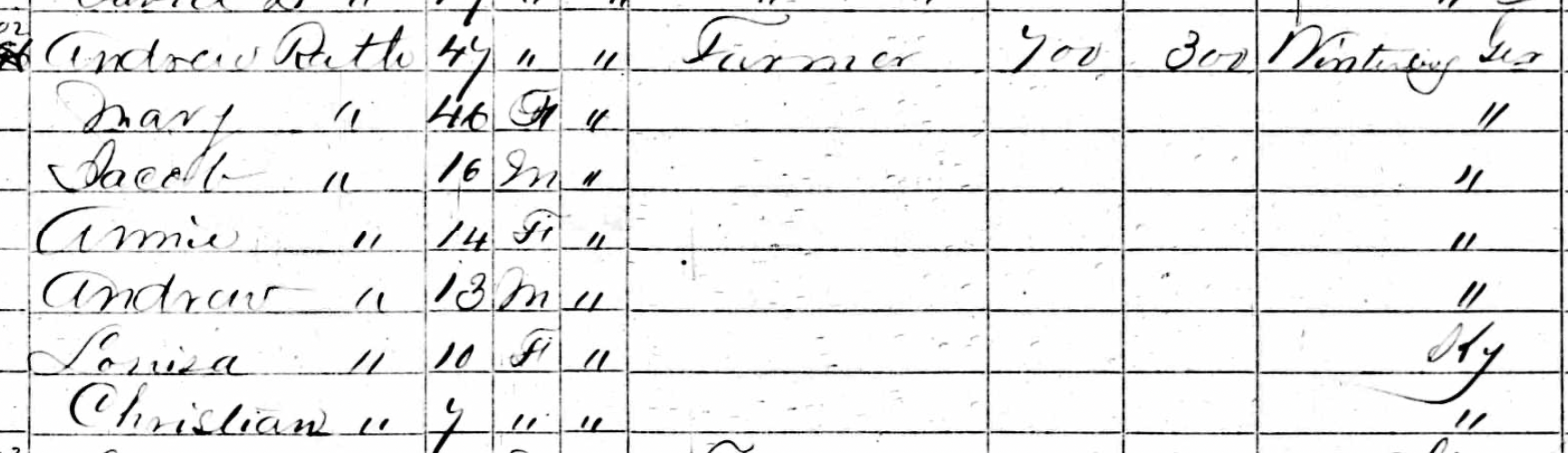
listing Andreas Rath as a farmer. (Public domain record.)
The Rath family lived through the tense years surrounding the Civil War, though Andreas did not serve. At the time of the conflict, he was in his forties and not within the usual age range for military enlistment. Like many German immigrants in the border states, he likely remained focused on maintaining his farm and keeping his family secure during a turbulent period.
Daily life in northern Kentucky during this era was demanding but community-oriented. German families often worshiped together, celebrated traditional holidays, and preserved their cultural practices even as they adapted to American life. For Andreas, these years represented both continuity with his past and the creation of a new foundation for the generations who would follow.
Marriage & Children
Andreas Rath married Maria (Mary) Gruhler on September 4, 1838, in the Lutheran parish church of Aldingen, Spaichingen district, Kingdom of Württemberg. (Some transcriptions list September 4, 1838 as the final marriage proclamation date, while the parish entry records the ceremony on September 5, 1838. Their marriage was formally entered into the village’s parish register, the same set of records that preserved the baptisms, confirmations, marriages, and burials of their families for generations.
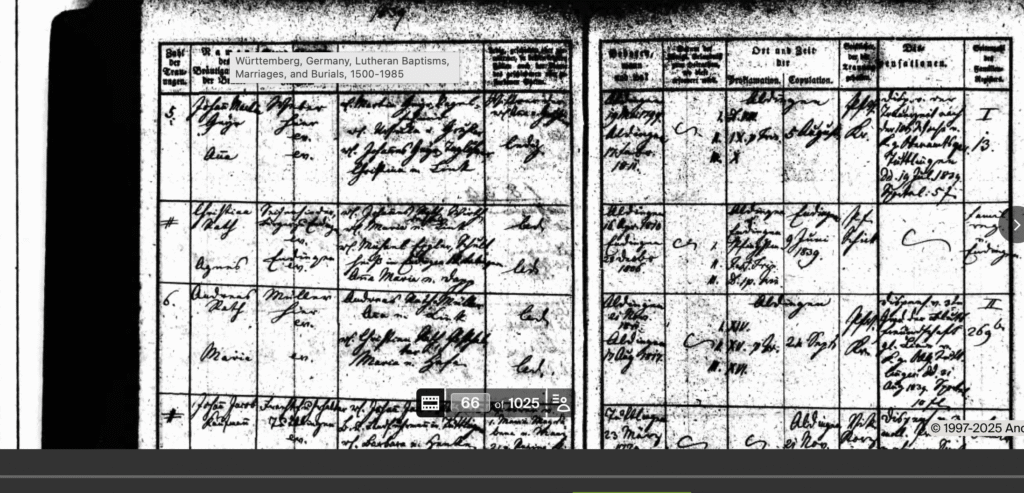
The record identifies Andreas as a miller’s servant and names both sets of parents,
as well as Maria’s father, Michael Gruhler, who served as a witness. (Public domain record.)
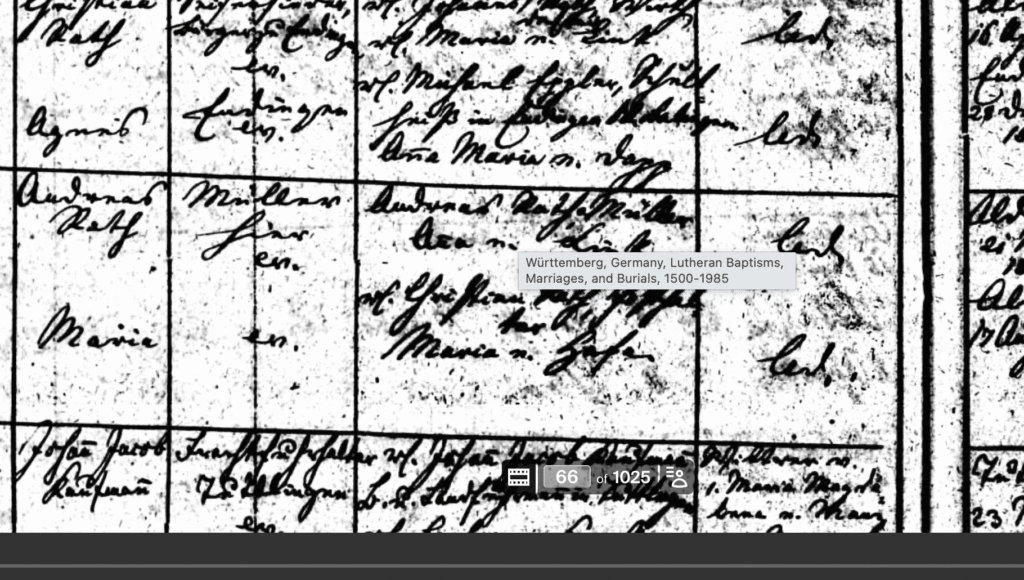
as a miller’s servant and naming both sets of parents. (Public domain record.)
The 1838 record clearly identifies Andreas as a Müllersknecht (miller’s servant), confirming that he worked in his father’s mill before immigrating to America. The record also names his father as Johannes Rath, a Müller (miller), and his mother as Ursula Glunz. Maria is listed as the daughter of Michael Gruhler and Maria (surname partly illegible), both of Aldingen.
Translation of the Marriage Record (from old German script)
Groom:
Andreas Rath, miller’s servant, unmarried, from Aldingen.
Son of Johannes Rath, miller in Aldingen, and his wife Ursula Glunz.
Bride:
Maria Gruhler, unmarried, from Aldingen.
Daughter of Michael Gruhler and his wife Maria (maiden name partially illegible).
Marriage:
Proclaimed according to church custom.
Married in the Lutheran parish church of Aldingen on 5 September 1838.
By the time Andreas and Maria left Württemberg in 1847, they were the parents of five children, all born in the same village where they themselves had grown up and married. Their decision to emigrate was made with a large, young family already depending on them—a choice that required extraordinary courage, planning, and hope for a better future.
The family appears in the 1850 U.S. Federal Census in northern Kentucky under the Americanized surname “Rate”, a phonetic spelling used by English-speaking census takers unfamiliar with German handwriting. Their given names also appear in Americanized form, but the household structure matches the family group from the ship manifest perfectly:
1850 Census Household (Americanized Names)
- Andrew Rate (Andreas Rath), 36
- Mary Grughler (Maria Gruhler), 35
- John (Johannes), 11
- Elias, 8
- Jacob, 7
- Ann (Anna/Annaliese), 5
- Andrew (Andreas Jr.), 4
Also living in the household were members of Maria’s family:
- Elias Gruhler, age 64 — her father
- Elias Gruhler, age 24 — her brother
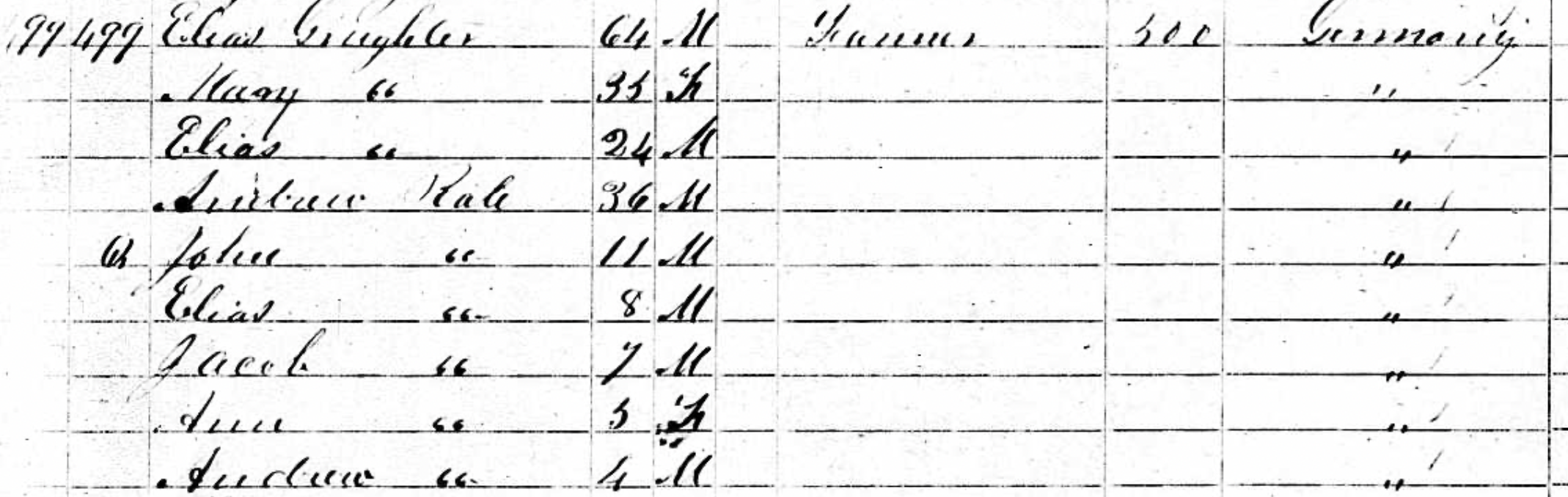
shortly after their arrival in America. (Public domain record.)
Their presence confirms the extended-family migration typical of many Swabian families.
After settling in Kentucky, Andreas and Maria welcomed four additional children, all born in Kentucky:
Children Born in Kentucky
- Louisa Rath — born July 10, 1851
- Christian Rath — born November 15, 1853
- Caroline Rath — born April 30, 1856
- Caroline does not appear in the 1860 or 1870 census, and no further records have been found. Based on her confirmed birth and absence from later documentation, it is likely that she died in infancy or early childhood, a common tragedy in rural mid-19th-century Kentucky.
- Amelia Rath — born March 1860; died at one month, cause unknown.
By the time of the 1870 Census, the Rath household reflected a blend of older children entering adulthood and younger children still at home. Andreas continued working as a farmer, and the family maintained close ties with other German immigrants in northern Kentucky.
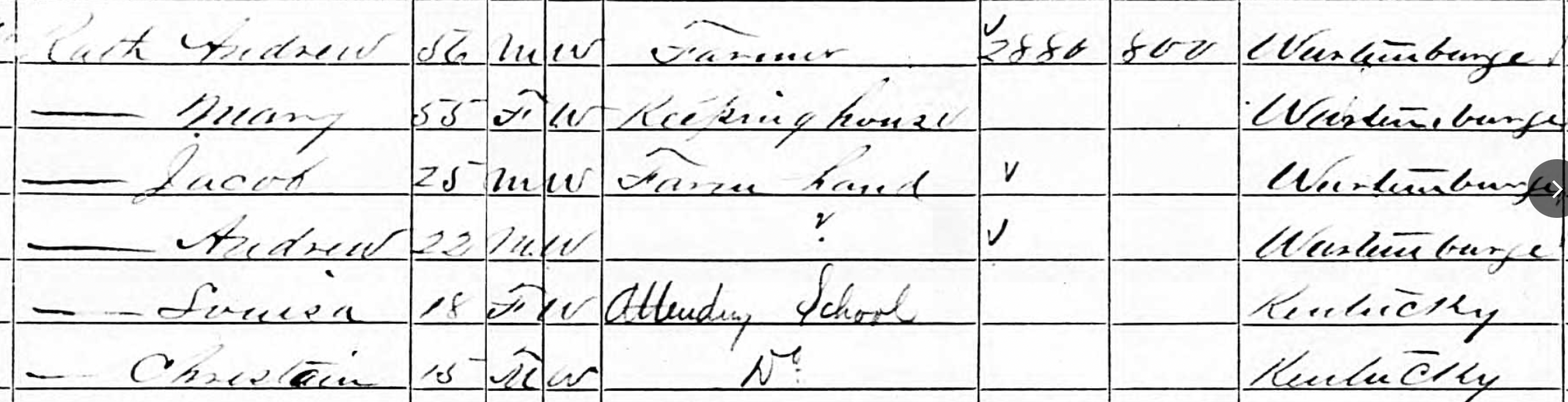
as they continued to build their life in rural Kentucky. (Public domain record.)
Together, Andreas and Maria raised a family of nine children, five born in Germany and four in Kentucky. Their marriage—rooted in a small Lutheran parish in Württemberg and carried across the Atlantic—formed the foundation of the Rath family’s American story.
Later Years & Death
By the 1870s, Andreas Rath was in his sixties and firmly established in northern Kentucky. Census records show him still working as a farmer, surrounded by several of his younger children and by a network of nearby German families who had settled in the same area. Life in rural Pendleton and Bracken counties remained simple and demanding: tending crops, caring for livestock, maintaining the household, and participating in church and community gatherings. Although Andreas had left Württemberg decades earlier, many aspects of his daily life in Kentucky would have felt familiar—rolling hills, close neighbors, shared work, and the steady rhythm of a farming community.

The 1870 Agricultural Schedule provides a detailed snapshot of Andreas Rath’s farm and the life he had built in rural Pendleton County. That year he owned 144 acres—60 improved and 84 in woodland—and operated a well-balanced German-style farm. His livestock included a horse, a mule, four milk cows, four other cattle, thirteen sheep, and six hogs, with a total animal value of $600. His grain harvest was substantial: 300 bushels of corn, 120 bushels of wheat, 40 bushels of oats, and 125 bushels of buckwheat. The schedule also records smaller but meaningful aspects of farm life: 11 bushels of Irish potatoes, 30 bushels of sweet potatoes, $10 in orchard products, 100 pounds of butter produced from his four milk cows, and 11 pounds of honey from his bee hives. Andreas also reported $110 in animals slaughtered or sold, and his total estimated farm production for the year was valued at $600. Together, these details reveal a capable and productive farmer who had carved out a stable and successful livelihood in Kentucky within two decades of his arrival from Württemberg.
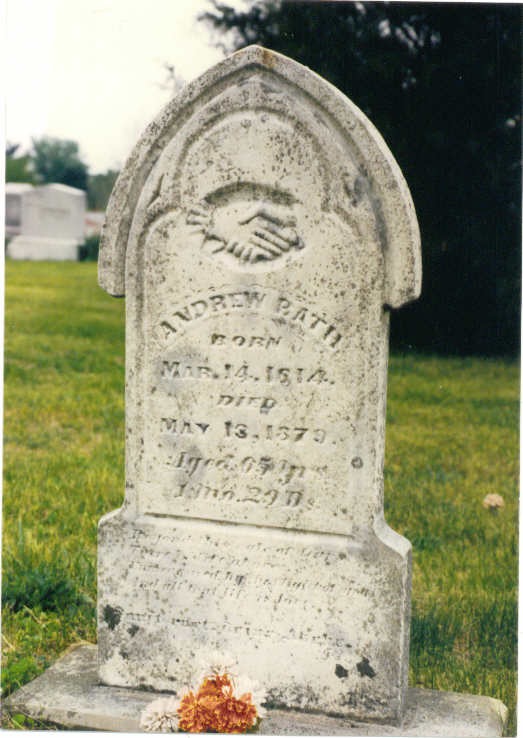
Andreas died on May 13, 1879, in Pendleton County, Kentucky. He was 65 years old, based on his confirmed birth date of March 15, 1814. No death certificate has been located, which is not unusual for rural Kentucky during this period—many counties did not consistently record deaths until the early 20th century. As a result, his cause of death remains unknown.
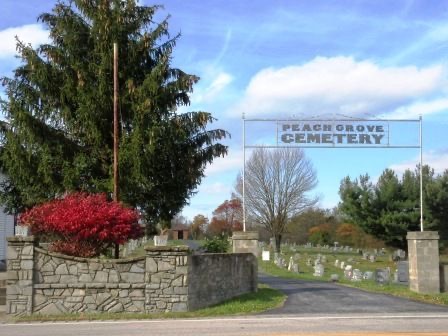
He was buried in the Old Peach Grove Cemetery in Peach Grove, Pendleton County, a quiet rural resting place not far from the home he built for his family. Several of his descendants, as well as members of the extended Gruhler family, would remain in this region for generations. His grave, set among the hills of northern Kentucky, marks the final chapter of a life that began in the Swabian Alps of Württemberg and carried him across an ocean, through hardship and hope, to a new beginning in America.
Sources Used in This Biography
Primary Records
Aldingen (Spaichingen District), Lutheran Parish Registers.
Birth, baptism, marriage, and family records for the Rath and Gruhler families. Evangelische Landeskirche in Württemberg (ELKW), Hauptstaatsarchiv Stuttgart. Accessed 26 November 2025.
United States. Bureau of Customs.
Passenger List of the Ship L’Unicorn, Arriving at New York, July 10, 1847. National Archives and Records Administration (NARA), Microfilm Publication M237, Roll 64. Accessed 26 November 2025.
United States. Seventh Census (1850).
Pendleton County, Kentucky. National Archives Microfilm Publication M432. Records for household enumerated as “Andrew Rate.” Accessed 26 November 2025.
United States. Eighth Census (1860).
Pendleton County, Kentucky. National Archives Microfilm Publication M653. Accessed 26 November 2025.
United States. Ninth Census (1870).
Pendleton County, Kentucky. National Archives Microfilm Publication M593. Accessed 26 November 2025.
United States. Ninth Census (1870), Agricultural Schedule.
Pendleton County, Kentucky. Non-Population Schedules, National Archives and Records Administration (NARA). Accessed 26 November 2025.
Kentucky Birth Records.
Pendleton County, Kentucky. Births for Louisa Rath (1851), Christian Rath (1853), Caroline Rath (1856), and Amelia Rath (1860). Kentucky Department for Libraries and Archives (KDLA). Accessed 26 November 2025.
Kentucky Cemetery and Burial Records.
Old Peach Grove Cemetery, Peach Grove, Pendleton County, Kentucky. Accessed 26 November 2025.
Find A Grave (Cemetery and Grave Documentation)
Find A Grave.
“Old Peach Grove Cemetery,” Cemetery ID 271857. Photograph by Cathy Case Muntz. Accessed 26 November 2025. https://www.findagrave.com/cemetery/271857.
Find A Grave.
“Andreas Rath,” Memorial ID 6479600. Memorial created by Norm Vahey, added 5 June 2002. Photograph of grave marker. Accessed 26 November 2025. https://www.findagrave.com/memorial/6479600.
Historical Images & Contextual Sources
Wikimedia Commons.
Michielverbeek. “Aldingen Mauritiuskirche.” Photograph. Licensed under CC BY 4.0. Accessed 26 November 2025. https://commons.wikimedia.org/wiki/File:Aldingen_Mauritiuskirche.jpg.
Wikimedia Commons.
Sir David Wilkie. “The Interior of Pitlessie Mill with a Man Sieving Corn,” 1818. Watercolor painting. Public domain. Accessed 26 November 2025.
Wikimedia Commons.
“Mid-19th Century Emigrant Ship Steerage Scene.” Engraving representing typical Atlantic crossing conditions. Public domain. Accessed 26 November 2025.
Wikimedia Commons.
“19th-Century Rural Frontier Farm Scene.” Public domain illustration depicting typical American farm life. Accessed 26 November 2025.
Historical and Cultural Background Sources
General historical references on:
• 19th-century Württemberg rural life and Swabian culture
• German emigration to the United States
• Settlement of German immigrants in the Ohio River Valley (Ohio, Indiana, Kentucky)
• Typical agricultural practices of mid-century German-American farmers
Accessed 2024–2025 through public-domain historical texts and regional history archives.
This post contains my personal research and writing. Please don’t republish or copy without permission. Genealogy is always a work in progress, so information may change as new records come to light.